


I have a former boss who (lovingly) told me he thought I had a “low shame receptor” (scientifically, this is apparently called “low shame proneness”). This was a good thing, he explained, because it meant I was unafraid to speak up in a room full of people who were many years my senior. I didn’t need coaching to present ideas to leadership, and I wasn’t afraid to deliver tough news.
And it’s true; I am missing whatever sparky little neurons tell people they don’t deserve to be heard, or that they’re not good enough, or that they don’t belong in a space. I take great care in my messaging, but I’m never afraid to deliver a message.
Being willing to give feedback and share ideas and call people out on their bullshit, regardless of their status relative to mine has served me well. I’m not intimidated by celebrities or unnecessarily deferential towards people who are above my station, because I fundamentally believe that we are all just people. I don’t believe in social hierarchy as a way to govern behavior.
Luckily for him (and for me), I also have a strong people-pleasing gene, so I’m led by empathy and a genuine desire to be kind to people (because again, we’re all just tiny meat sacks wandering a lil planet in a huge and ever-expanding universe…none of us are naturally more deserving than others).

An example: One of my favorite things to do in my role as an HR exec is to take egomaniacal execs down a peg; that is, helping them change their behavior while making them believe it was their idea all along. Manipulation? Maybe a little. (and is this an exaggeration? ummm I’ll let you wonder). While I’m being a bit cheeky here, this leadership development skill is crucial to my work with leaders of all types. You can’t coach an exec if you’re deferring to them - you have to be able to push them into a new way of thinking. Behavior change is hard. A good partner has to have a strong spine, thick skin, and a genuine desire to help someone become a better version of themselves.
So much of working with leadership is just knowing your audience and understanding what they need to succeed - leadership development requires effective communication.
I started my corporate career as an Administrative Assistant, working with a team of over 300 Engineers (directly supporting 2 VPs and 6 Directors, indirectly supporting higher-up execs whose names you definitely know). I nudged some behavior changes I’m extremely proud of, and learned that when there’s a significant power differential, you really have to work to make the more senior person understand the “why”. There is no “because I said so” when it comes to people who see themselves as above you.
And if you aren’t wasting your energy trying to be brave enough to speak to them, you have a lot more capacity to focus on what you need to do.

I know it’s not as easy as just “be more confident” or “just don’t have imposter syndrome,” truly I do.
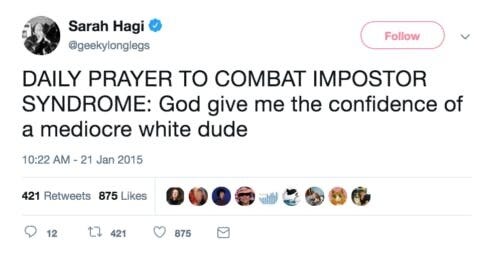
But what would it look like if you pretended to be as confident as you want to be? If you just…assumed that people wanted to hear from you? If you went into a room believing you deserved to be there? If you had the confidence of a mediocre white dude?
I’ve spent a lot of time in customer-facing roles, whether I was explaining for the millionth time why yes, even you, esteemed professor, need to wear the special white gloves while reviewing this ancient musical score, or helping an actor rewire his relationship to a character when the playwright ripped up pages and presented something totally new (both actual true stories). Helping a sweetly hapless executive remember to save his travel receipts so I could do his expense reports. Convincing a severely introverted leader that she could host a gathering for her team in a way that still made her feel comfortable. Gently prodding a CEO to think about the way their messaging was being received, when I knew they meant well but were absolutely going to confuse and disengage people with their choice of words. Coaxing a Marketing leader to rethink their stance on public messaging during a global crisis.
Once you stop caring how people see you and just act in integrity,
the delicate balance feels less precarious and more powerful.
In most of these scenarios, I had never encountered the exact situation before. But perhaps because of my improv training, or my eldest-daughter temperament, or my missing brain chemistry, I just assumed that I would figure it out. They didn’t make a mistake in hiring me: and even if they had, I was here and I could either go quiet or get the job done.
Giving assertiveness without aggression, respect without total deference. Being patient, but not a pushover. It’s not unlike the experience of all women everywhere forever. But once you stop caring how people see you and just act in integrity, the delicate balance feels less precarious and more powerful. I love it.

About a month ago, I was having a deep heart to heart with a close friend, the kind where you learn things about each other that haven’t come up in nearly 10 years of friendship. Where you read tarot on the display furniture at the CB2 outlet until the salesperson asks if you have any questions about the couch (obviously we did not). Where you ask questions like, “so wait, you really don’t ever feel shame?” and do a brief psychoanalysis before shrugging and saying I guess that’s just how my brain is wired. Discomfort, sure. My confidence sometimes falters, I’m still human, I promise. I experience rejection sensitive dysphoria and worry that I will let people down.
But shame? Don’t really know her.
But it got me thinking about confidence, and how my instinct is to always downplay my confidence, to call it “unearned.” But that stops now.
“Confidence is not about being able to do shit...
Confidence is showing up, and trying, and not giving up
because deep in your heart
you know who you are and what you’re capable of.”
- Ali Hazelwood, Deep End
I’m confident because I know what’s possible. I’m not always certain (though my husband would tell you I absolutely act like I am more than I should…and he wouldn’t be wrong). Sometimes it’s hard for me to pause and think about whether I’m sure of myself because of real knowledge/experience/information, or whether I’m just not used to be ing wrong in a particular situation. My brain plays tricks on me and tries to jump straight to figuring it out before I’ve gathered all of my research. I’m a work in progress.
But I want to encourage everyone reading this to think about why you question yourself. Is it because you genuinely don’t know what to do, or because you’re afraid that you do?
Don’t be afraid to be right - if you’re worried about appearing too cocky or aggressive, I guarantee you aren’t.
But if you’re staying quiet because you’re not sure you deserve to be heard?
If you’re filling your email in with loads of compliments to subtly convince the recipient that you’re good enough to pay attention to?
If you’re avoiding conflict because you don’t want to make someone angry?
Time to buck up, buttercup.
Because this is a big, big world and you deserve to take up space.